


What lies behind your everyday AI prompts?
A look ahead to 2030 by the Kyiv Consulting Research & Analytics Hub.

OCTOBER 2026 | 8 mins read
We use AI every day, often without thinking about what makes it possible. Behind every prompt, search or AI-generated image is a much larger physical system — one that requires chips and servers, data centres, electricity, cooling, water, land and critical minerals. As AI use grows, so does the demand for the physical resources and infrastructure that keep it running.
The challenge is that AI adoption is accelerating faster than some of the physical systems needed to support it. Power grids, transformer capacity, water availability, access to data-centre sites and vulnerabilities across the critical-material supply chains can all become constraints on further expansion. At the same time, building and operating this infrastructure creates environmental impacts that extend well beyond the AI applications itself.
To understand the scale of this challenge, we need to look at what sits behind AI and where its physical footprint begins.

Existing AI environmental impact studies are mainly concentrated on training and inference, with other stages of the life cycle much less examined.
AI has two main types of physical footprint. The first emerges before a model even starts operating: raw minerals must be extracted, chips and servers manufactured, data centres built and cooling, power and network infrastructure installed. This can be described as the embodied footprint — the environmental burden embedded in manufacturing, construction and equipment.
The second develops during AI operation. Once deployed, data centres continuously consume electricity and require cooling, water and supporting network infrastructure. This is the operational footprint — the environmental impact that accumulates over the system’s lifetime.
Overall, AI’s physical footprint spans the full chain: from raw minerals, chip manufacturing and servers to data centres, power grids, cooling systems, ongoing AI operations and ultimately hardware replacement and e-waste.
| AI lifecycle stages | What physically happens | Physical footprint |
|---|---|---|
| Hardware Manufacturing | GPUs/accelerators, CPUs, memory, servers and networking equipment are manufactured. | Metals and critical minerals, water, energy, semiconductor fabrication facilities, manufacturing emissions. |
| Infrastructure Construction | Data centres and the infrastructure surrounding servers are built. | Embodied carbon emissions, land, concrete, steel, transformers, substations, cooling systems and grid connections. |
| Dataset Creation & Preprocessing | Data is collected, stored, cleaned and processed. | Servers, data storage, electricity and data-centre capacity. |
| Model Experimentation & R&D | Multiple experiments and test runs are performed. | Compute, electricity, cooling and water. |
| Model Training | Large computing clusters operate continuously from days to months. | High electricity demand, cooling, water and GPU utilisation. |
| Post-Training Adaptation | Models are fine-tuned, optimised and adapted, including through RLHF. | Additional compute, electricity and cooling. |
| Deployment & Inference | Models are deployed and used continuously by large numbers of users. | Continuous electricity use, servers, cooling and network infrastructure. |
| End-of-Life & Decommissioning | Servers, GPUs and other hardware are replaced, retired or decommissioned. | E-waste, recycling, discarded metals and electronic components. |
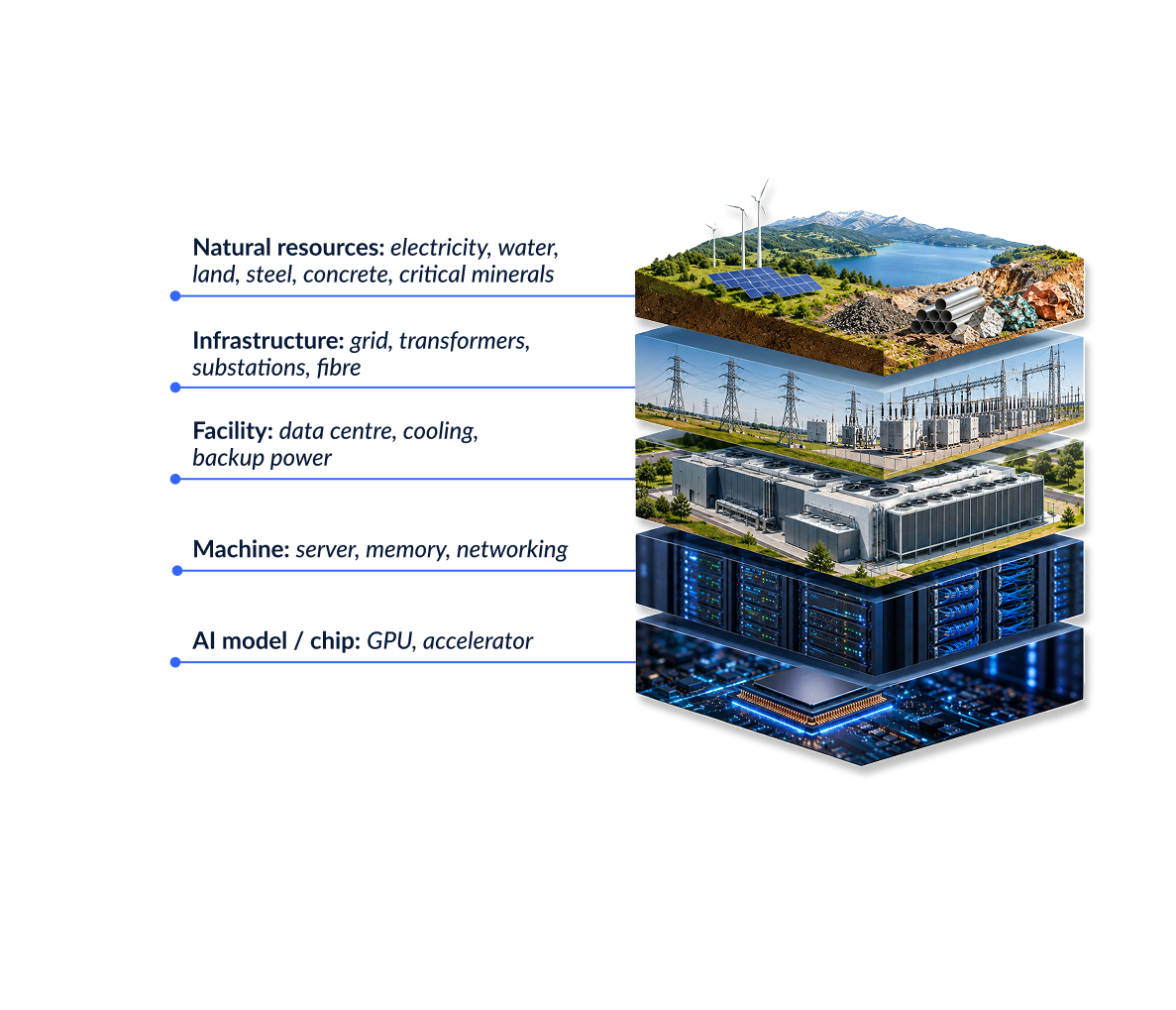
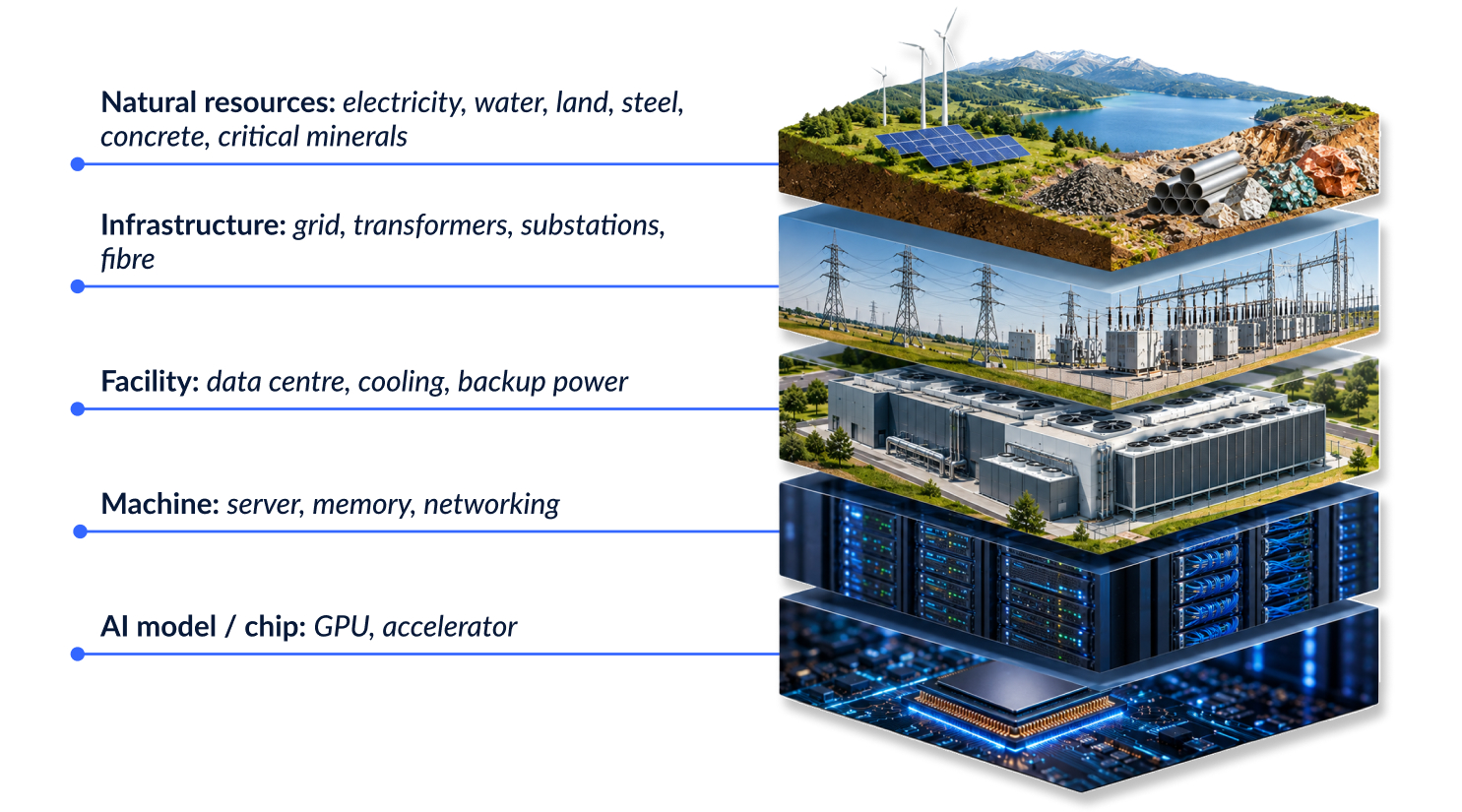
The further we zoom out from the AI model, the larger its physical footprint becomes. The physical system behind AI can be seen as five layers. At the centre is the AI model and chip: a GPU or accelerator. Around it is the machine, made up of servers, memory and networking. Next comes the facility: the data centre, its cooling and backup power. Beyond that sits the infrastructure: the grid, transformers, substations and fibre. At the outermost layer are the natural resources on which the whole system depends: electricity, water, land, steel, concrete and critical minerals.
First-party disclosures from Microsoft and Google confirm that AI growth is translating into a larger physical infrastructure footprint. Microsoft reports rising demand for energy, water, land and materials as it scales AI infrastructure. Google states that its AI infrastructure build-out is accelerating faster than the grid is decarbonising, while its electricity demand increased by 37% year on year in 2025.
According to JLL's 2026 Global Data Center Market Outlook, AI’s footprint extends far beyond chips and software. It depends on large volumes of critical minerals. A 2026 study published in Communications Earth & Environment estimated that a single GPT-4 training run consumed the equivalent lifetime capacity of ~2,515 NVIDIA A100 GPUs, corresponding to ~3.75 tonnes of analysed GPU materials, with copper, iron, tin, silicon and nickel accounting for the largest shares by mass, while the rapid expansion of hyperscale data centres is increasing demand for land, steel, concrete and power infrastructure. Global data-centre capacity and electricity consumption are expected to nearly double by 2030, with AI accounting for an increasingly significant share of workloads.
At the same time, growing demand for transformers, generators, cooling systems and grid connections is creating infrastructure bottlenecks. Copper has emerged as a particularly important resource because much of it is required for electricity transmission and distribution: a 2026 bottom-up study found that copper accounts for around 83% of the total modelled mineral mass required for AI data-centre expansion.
AI is also increasing pressure on water resources, especially as many new data centres are being built in water-stressed regions: a 2026 Water Research study estimates the global AI water footprint at 4.2–6.6 billion m³ by 2027. Around two-thirds of data centres built after 2022 are located in water-stressed regions.
Looking ahead, the environmental footprint will continue to grow through greater land use and rising volumes of e-waste generated by hardware replacement cycles: AI infrastructure could generate up to 2.5 million tonnes of e-waste annually by 2030.
| Resource | AI physical layer | Evidence |
|---|---|---|
| Critical minerals | Chip / Hardware | A 2026 study estimated that a single GPT-4 training run consumed the equivalent lifetime capacity of ~2,515 NVIDIA A100 GPUs, corresponding to ~3.75 tonnes of analysed GPU materials, with copper, iron, tin, silicon and nickel accounting for the largest shares by mass. |
| Land / steel / concrete | Facility | The number of hyperscale data centers worldwide more than tripled, from 430 in 2018 to 1,360 by the end of 2025. Their total capacity expanded even faster, reflecting the increasing scale of new facilities, increasingly driven by AI workloads. |
| Electricity / power capacity | Facility | Global data-centre capacity is projected to increase from approximately 103 GW in 2025 to 200 GW by 2030. JLL expects AI to account for around 50% of global data-centre workloads by 2030. |
| Power & cooling equipment | Facility / Infrastructure | AI data-centre expansion is creating physical bottlenecks beyond chips: demand is surging for transformers, generators, power-distribution and cooling systems. Global data-centre investment could approach $7 trillion by 2030, while grid-connection delays in some developed markets already exceed eight years. Liquid cooling could be deployed in ~70% of new AI data centres by 2030, versus ~30% today. |
| Copper | Infrastructure | A 2026 bottom-up study found that copper accounts for around 83% of the total modeled mineral mass required for AI data-centre expansion. Around 64% of the copper requirement is linked to electricity transmission and distribution infrastructure, including grid connections, substations, transformers and power cables. |
| Electricity | Resource base | Global data-centre electricity consumption is projected to more than double from 448 TWh in 2025 to 945 TWh by 2030. AI’s share could rise from around 20% to 40%, implying approximately 378 TWh of electricity demand attributable to AI workloads by 2030. |
| Water | Resource base | A 2026 Water Research study estimates the global AI water footprint at 4.2-6.6 billion m³ by 2027. Around two-thirds of data centres built after 2022 are located in water-stressed regions. |
| Land | Resource base | UNU estimates that the land footprint associated with the projected global data-centre electricity system could exceed 14,500 km² by 2030. |
| E-waste | End of life | AI infrastructure could generate up to 2.5 million tonnes of e-waste annually by 2030. |
INFRASTRUCTURE
The JLL's evidence shows that AI’s footprint extends far beyond chips and software. It depends on large volumes of critical minerals such as copper, iron, silicon and nickel, while the rapid expansion of hyperscale data centres is increasing demand for land, steel, concrete and power infrastructure. Global data-centre capacity and electricity consumption are expected to nearly double by 2030, with AI accounting for an increasingly significant share of workloads.
At the same time, growing demand for transformers, generators, cooling systems and grid connections is creating infrastructure bottlenecks. Copper has emerged as a particularly important resource because much of it is required for electricity transmission and distribution. AI is also increasing pressure on water resources, especially as many new data centres are being built in water-stressed regions. Looking ahead, the environmental footprint will continue to grow through greater land use and rising volumes of e-waste generated by hardware replacement cycles.
FOOTPRINT
AI’s physical footprint extends far beyond the GPU itself. Operating AI at scale requires servers, data centres, cooling systems, power distribution equipment and grid infrastructure, creating demand for materials such as copper, steel, concrete and critical minerals. A significant share of this footprint comes from supporting infrastructure, including substations, transformers and power networks, rather than the servers alone. Water and land are also essential inputs, supporting chip manufacturing, electricity generation, cooling and data-centre operations. Overall, AI’s footprint consists of an embodied component linked to materials, hardware and construction and an operational component linked to electricity, cooling and water consumption. The impact also extends beyond the useful life of equipment through hardware replacement and the generation of e-waste.

CONSULTING IMPACT
As AI adoption accelerates, consulting opportunities are extending beyond traditional technology advisory into infrastructure planning, energy management, supply chain resilience, resource efficiency, sustainability and regulatory compliance.
01
Demand for consultancy services is following suit. Source Global forecasts 15% growth in AI advisory and implementation in 2026, well above the broader consultancy market at 6%.
02
Scaling AI increasingly depends on power, grid capacity, cooling, water, land and critical materials — areas directly relevant to Energy, Resources and Infrastructure advisory. Energy and Resources will be the fastest-growing consulting sector in 2026, at 10%, supported by demand for risk management, supply chain resilience and geopolitical risk advisory.
03
The consulting opportunity is broadening into energy strategy, infrastructure planning, supply-chain resilience, site selection, sustainability, risk and regulatory advisory as organisations address the physical requirements of AI at scale.
The physical footprint of AI is the infrastructure, materials and natural resources required to build, operate and replace AI systems. It includes chips, servers, data centres, electricity, cooling systems, power grids, water, land and critical minerals. AI therefore has a physical and environmental footprint that extends far beyond the software or model itself.
AI affects the environment through both the construction of its physical infrastructure and the resources consumed during operation. Manufacturing chips and servers requires materials, energy and water, while data centres require electricity, cooling, land and grid infrastructure. Hardware replacement also creates electronic waste. As AI adoption grows, these combined impacts increase across the full AI infrastructure lifecycle.
AI at scale depends on electricity, water, land, data-centre capacity and critical materials. Its physical infrastructure requires copper, steel, concrete and critical minerals, as well as servers, cooling systems, transformers, substations, power networks and fibre connectivity. As AI workloads expand, demand for these supporting resources and infrastructure also increases.
AI models require substantial computing capacity for training, deployment and continuous inference. These workloads run on specialised chips and servers housed in data centres, which require electricity, cooling and network connectivity. Scaling AI also creates additional demand for transformers, substations, grid connections and backup power infrastructure, meaning the energy requirements extend beyond the servers themselves.
Water is part of the AI infrastructure lifecycle. It can be required for semiconductor manufacturing, electricity generation and data-centre cooling. As the number and capacity of AI data centres increase, water availability may therefore become an important infrastructure constraint, particularly in regions already experiencing water stress.
The physical footprint of AI is growing because wider AI adoption requires more computing capacity, larger data centres and supporting energy infrastructure. This increases demand for electricity, cooling, water, grid capacity, land, construction materials and critical minerals. The footprint also grows as organisations replace servers, GPUs and other hardware to support more powerful AI workloads.
AI's embodied footprint is created before and during infrastructure construction. It includes raw-material extraction, chip and server manufacturing, construction of data centres and production of supporting equipment. The operational footprint is generated while AI systems are running and includes the electricity, cooling, water and network infrastructure required throughout their operating life.
Data centres are a central part of AI's physical footprint because they house the GPUs, servers, memory and networking equipment used to train and operate AI models. They also depend on cooling systems, backup power, transformers, substations and grid connections. Their expansion therefore creates additional demand for electricity, water, land, steel, concrete, copper and other infrastructure resources.
Businesses scaling AI may need to consider more than technology, software and data. Long-term AI deployment increasingly depends on energy availability, data-centre and grid capacity, water and cooling requirements, supply-chain resilience, sustainability, regulation and access to critical infrastructure and materials. These factors can affect where and how organisations deploy AI infrastructure at scale.
INSIGHTS

Get a comprehensive analysis on how big data benefits small businesses.

Looking to invest in Ukraine? Discover key insights, market trends, and opportunities from leading business consultants. Make informed investment decisions.

Uncover if SFDR is truly tackling greenwashing. Discover real challenges, regulatory gaps, and what ESG fund transparency means for investors in the EU.
READY TO TALK?
Please fill in the field.
Please fill in the field.
Please fill in the field.
Please fill in the field.
Please fill in the field.
Please fill in the field.